

Academy Sports and Straw Purchasing of Firearms: A Case Study
Introduction and Executive Summary
Academy Sports, a publicly owned, multi-billion-dollar sports and outdoors retailer with more than 300 stores across the country, tells the public that its “goal is to be the most responsible seller of firearms in the country.”1Acad. Sports & Outdoors, 2021 Environmental, Social, and Governance Report 9 (2022), https://corporate.academy.com/wp-content/uploads/corpresponsibility/Academy_ESG_Report_May11_2022.pdf. But an extensive investigation by Everytown Law—drawing on records of multiple federal prosecutions of gun traffickers—shows strong evidence that, between 2020 and 2023, Academy repeatedly sold firearms to illegal straw purchasers despite clear warning signs. Specifically, the facts detailed in these court filings, along with other information set forth below, show that, during the 2020 to 2023 time period, 20 Academy stores spread across Arkansas, Georgia, North Carolina, and South Carolina sold over 250 guns to individuals whose purchasing patterns and conduct exhibited a range and combination of red flags recognized by the ATF as indicia of illegal purchasing. Straw purchasers are proxy buyers who unlawfully purchase firearms on behalf of other people, most often individuals prohibited by law from buying guns, typically because of a criminal record that prevents them from passing a background check. These illegal straw purchases of Academy guns fed large-scale interstate gun trafficking operations that moved over 250 Academy guns along the “Iron Pipeline”2Schemes involving interstate firearms trafficking often move firearms along one of several well-known routes, including the Iron Pipeline, which runs from southern states with weaker regulation of firearms sales to northeastern states with stronger regulation. See, e.g., Gregor Aisch & Josh Keller, How Gun Traffickers Get Around State Gun Laws, N.Y. Times (Nov. 13, 2015), https://www.nytimes.com/interactive/2015/11/12/us/gun-traffickers-smuggling-state-gun-laws.html. into New York City and surrounding suburbs, Philadelphia, Washington, D.C., New Haven, and Boston. Many of these Academy guns have already been recovered at crime scenes, including in connection with multiple shootings and in the possession of individuals convicted of felonies as well as minors.
While we do not know—and public records do not reveal—whether these business practices continued past 2023, consider the following examples identified from the facts set forth in the federal prosecutions:
First, in January 2025, an Arkansas resident pleaded guilty in federal court in New York to charges arising from his participation in a trafficking ring that moved over 130 guns from the retail market in Arkansas to the black market in New York.3See Jan. 10, 2025, Minute Entry, United States v. Booker, No. 22-cr-00489 (E.D.N.Y. Jan. 10, 2025). See also Indictment, United States v. Booker, No. 22-cr-00489, ECF No. 1 (E.D.N.Y. Oct. 26, 2022). 111 of the guns trafficked by this ring were sold to this single straw buyer by three Academy stores in just over four months, between September 2020 and January 2021, and notwithstanding the presence of multiple well-recognized red flags of straw purchasing. At its height, Academy’s sales to this buyer included a single-transaction sale of 15 guns, as well as a spree of 50 guns sold by two stores to the straw buyer over a two-week period, including 31 identical or near-identical pistols. A single Academy store—in Benton, Arkansas—sold this buyer 54 of the 111 guns. All of the purchases were made with cash. As of November 2022, the New York City Police Department (NYPD) had already recovered at least 12 of the guns sold by Academy to this buyer, including one in the possession of a person with a felony conviction and one in the possession of a minor.
Second, as part of another massive trafficking operation resulting in federal criminal charges in 2022, four Georgia-based straw purchasers (all of whom have pleaded guilty) bought a combined 119 guns from 13 Academy stores in the Atlanta area over the course of just five months, between July and November 2020, and trafficked them to the Philadelphia area.4See Second Superseding Indictment, United States v. Norman, 22-cr-00098, ECF No. 158 (E.D. Pa. Jan. 5, 2023); see also Indictment, United States v. Norman, 22-cr-00098, ECF No. 1 (E.D. Pa. Mar. 17, 2022) (initial indictment charging all four straw purchasers). As further detailed below, Academy’s sales to each of these four individuals involved purchases of duplicate guns and/or repeated bulk purchases over a short period of time. Recognized red flags were present both within individual stores and spread across multiple stores, including multiple stores selling 67 pistols to a single straw purchaser over a five-month period and 28 pistols to another straw purchaser over an 11-week period. At least three of those guns have already been recovered by law enforcement in Philadelphia (two) and New York City (one).
Several of these same Academy stores in the Atlanta area also sold guns involved in two additional straw purchasing schemes, as further outlined below. Two of these Academy locations sold one straw purchaser eight guns over two days. Federal criminal indictments show the recovery in Washington, D.C. of at least one gun sold by these stores, which has been linked to multiple shootings and an armed carjacking, as well as three guns recovered by law enforcement on Long Island, New York, including one in connection with a robbery.5See U.S. Omnibus Mem. in Aid of Sentencing, United States v. Bournes, No. 23-CR-74, ECF No. 58 (D.D.C. Feb. 23, 2024); Gov’t Sentencing Mem., United States v. Wolfolk, No. 22-cr-00347-JMA, ECF No. 40 (E.D.N.Y. Sep. 27, 2023).
Third, as part of a firearms trafficking scheme that moved guns from North Carolina to New Haven and elsewhere, also resulting in federal criminal charges relating to dozens of trafficked firearms, two straw purchasers bought nine pistols from two Academy stores between January and May 2021.6Indictment, United States v. Squire, Nos. 4:22-CR-19-1FL, 4:22-CR-19-1FL, 4:22-CR-19-1FL, 4:22-CR-19-1FL, ECF No. 1 (E.D.N.C. Mar. 16, 2022). At least two of those transactions bore recognized red flags of straw purchases, according to facts set out in federal criminal filings. Specifically, one of the straw buyers and a co-conspirator purchased a combined four pistols in two transactions from Academy’s store in Greenville, North Carolina, over the course of just four days. During the first of these sales, it is alleged that the straw purchaser filled out the purchase paperwork while the co-conspirator paid (in cash) for the guns. During the second sale, it is alleged that the co-conspirator entered the store and selected the guns, and then the straw purchaser entered the store and completed the purchase paperwork. Both have pleaded guilty.
Fourth, in April 2023, an Academy store in Columbia, South Carolina sold a straw purchaser four identical pistols on a single day.7See Aff. in Supp. of Pre-Trial Det., United States v. Roache, No. 24-cr-10001-LTS, ECF No. 16 (D. Mass. Jan. 12, 2024); Sentencing Mem. of the United States, United States v. Roache, No. 24-cr-10001-LTS, ECF No. 64 (D. Mass. Feb. 4, 2025). This sale also bore well-known markers of straw purchasing according to federal charging documents, including not only the sale of multiple duplicate guns in one day, but also the straw buyer paying $883.16 with the actual purchaser’s credit card (as well as $240 in cash). All four of the pistols purchased on that single April day have already been recovered by law enforcement in Boston, three on persons without valid Massachusetts pistol permits. One of the three was linked to a shooting that occurred in Boston just 15 days after the sale, in which two individuals sustained multiple gunshot wounds, while another was recovered in the possession of a minor. (This same straw purchaser bought 20 other guns as well, including one additional firearm purchased from Academy, and has pleaded guilty.)
To be clear, we are not aware of Academy or any of its employees or Board members being prosecuted, civilly sued, or found liable for any of the firearms sales or sales practices discussed in this report, except for the one prior civil lawsuit against Academy expressly noted below. Nor do we know what if any action Academy may have taken against employees or managers responsible for the sales discussed herein. While we cannot rule out the possibility that Academy proactively reached out to law enforcement in one or more of the cases detailed in this report (beyond filing the legally required multiple sales reports as discussed below, and running required background checks), our review of the facts as reflected in publicly available records and other information set forth below does not indicate that it did so. We also are not aware of whether and to what extent Academy stores and employees may have thwarted other straw purchases unrelated to those described in this report. We note as well that Academy reported an average of approximately $400 million in annual sales under the “firearms” category over fiscal years 2020-2023, which means that the 250 guns discussed herein represent only a very small percentage of its overall sales. At the same time, the 250+ guns figure captures only those Academy firearms implicated in publicly charged criminal cases, and the actual number of straw sales at Academy stores in recent years could be significantly higher. As further indicated below, many of the straw purchasing prosecutions that are the focus of this report involved purchases from multiple other licensed retailers as well, not just Academy stores; the focus of this report, however, is on Academy, which was the only retailer that was a significant source—and often the largest source—of the straw purchasing across all of the prosecutions that give rise to this report.
The facts detailed in the criminal cases described above and discussed further below illustrate the severe threat to public health and safety presented by straw purchasing schemes. Straw purchases from federally licensed dealers like Academy represent one of the leading diversion vectors for trafficked firearms.8See ATF, National Firearms Commerce and Trafficking Assessment: Firearms Trafficking Investigations – Vol. III – Part III at 1 (2024), https://www.atf.gov/firearms/docs/report/nfcta-volume-iii-part-iii/download. Between 2017 and 2021, at least 37,749 firearms were trafficked into the illegal market by straw purchasers across the country. ATF, National Firearms Commerce and Trafficking Assessment: Firearms Trafficking Investigations – Vol. IV – Part IV at 4 (2024), https://www.atf.gov/firearms/docs/report/nfcta-volume-iv-part-iv-%E2%80%93-firearm-trafficking-investigations/download. In the words of the U.S. Bureau of Alcohol, Tobacco, Firearms and Explosives (ATF), “[s]traw purchased firearms often end up in the hands of criminals and are used in violent crimes, including homicides, robberies, and gang-related activities.”9ATF, Don’t Lie for the Other Guy (Dec. 20, 2024), https://www.atf.gov/firearms/dont-lie-other-guy. The National Shooting Sports Foundation (NSSF)—a prominent gun industry trade organization—estimates that “[a]lmost half of all illegal gun trafficking results from straw person sales.”10NSSF,2023 Firearm Industry Compliance Webinar Series: Let’s Take a Look at Your Straw Purchase Avoidance Program 31(2023), https://perma.cc/W2QF-DNKR. According to a recent ATF analysis, nearly 60 percent of surveyed trafficking investigations involved at least one end user with a felony conviction, and 29.1 percent involved at least one end user who was a known gang member or associate.11ATF, National Firearms Commerce and Trafficking Assessment: Firearms Trafficking Investigations – Vol. III – Part VI at 13 (2024), https://www.atf.gov/firearms/docs/report/nfcta-volume-iii-part-vi/download. Where the ATF was able to obtain sufficient information to calculate, it found that 23.5 percent of its straw purchasing investigations involved a firearm that was later used in a shooting.12ATF, National Firearms Commerce and Trafficking Assessment: Firearms Trafficking Investigations – Volume III, Part IX at 5 (2024), https://www.atf.gov/firearms/docs/report/nfcta-volume-iii-part-ix/download (analyzing relevant investigations from 2017 to 2021). In short, “straw purchasing contributes to overall gun violence.”13ATF, Don’t Lie for the Other Guy (Dec. 20, 2024), https://www.atf.gov/firearms/dont-lie-other-guy.
The ATF also makes clear that federally licensed firearms dealers like Academy are “the first line of defense” against straw purchasing.14Id. Indeed, “Congress chose to make the dealer the ‘principal agent of federal enforcement’ in ‘restricting [criminals’] access to firearms.’” Abramski v. United States, 573 U.S. 169, 186 (2014) (quoting Huddleston v. United States, 415 U.S. 814, 824 (1974)). A company that acquires one or more licenses to deal in firearms thus takes on a clearly established and critically important responsibility to guard against straw purchasing.
Licensed firearms retailers that sell firearms to individuals they know or have reasonable cause to believe are straw buyers violate their obligations under the federal Gun Control Act and—depending on the jurisdiction—state law as well. Such violations, if proven, can provide grounds for not just civil liability but also license revocation and even criminal penalties for both the retailer and its firearms salespeople and managers.
The straw sales detailed in this report are not the first to raise the possibility of legal consequences flowing from Academy’s firearms-related sales practices. For example, in November 2023, without admitting liability, Academy agreed to pay $2.5 million to settle a 2018 civil action filed by the families of three people killed with one of multiple guns sold to a straw purchaser by Academy stores in Greenville and Spartanburg Counties, South Carolina.15Greg Lickenbrock, Academy Sports Settles Lawsuits for Straw Purchases, The Smoking Gun (Nov. 29, 2023), https://smokinggun.org/academy-sports-settles-lawsuits-for-straw-purchases/; Press Release, Brady, Brady, Victims’ Families Reach Settlement Agreement with Negligent Firearms Dealer Academy Sports in Todd Kohlhepp Murder Case (Nov. 27, 2023), https://www.bradyunited.org/press/brady-victims-families-settle-academy-sports. The court record in that case included allegations that Academy had deficient sales practices and training surrounding straw purchasing of firearms.16See, e.g., Exhibit 3 to Def.’s Mem. Opp. Pls.’ Mot. Compel at 33, 36-37, Coxie v. Academy, Ltd., No. 2018-CP-42-04297 (S.C. Ct. Com. Pl. Seventh Jud. Cir. June 22, 2023). (Academy disputed these allegations, as noted further below.)
It is important to underscore that the straw purchasers and traffickers involved in the trafficking operations described in this report have been prosecuted and are being held accountable by the criminal justice system. Such criminal prosecutions are vitally important in the fight against gun violence. But Academy, as a large-scale federally licensed seller of firearms, has a critical gatekeeper role to play here as well in recognizing and preventing straw purchasing, and it is Academy’s conduct in that gatekeeping role that is the subject of this report.
This report includes three parts. Part A explains the common and well-known red flags of straw purchasing that put licensed dealers on notice that a buyer is a straw purchaser. Part B provides an overview of the pertinent legal obligations of licensed dealers, primarily under the federal Gun Control Act. Part C pulls together the facts from multiple recent criminal prosecutions showing that Academy stores repeatedly sold firearms to buyers whose purchase patterns and/or behavior exhibited well-established red flags of straw purchasing and/or trafficking. It then provides a detailed account—obtained from a straw purchaser—of how Academy employees encouraged bulk purchasing by that straw purchaser. Finally, Part C summarizes some of the legal and public safety implications created by such conduct and outlines some of the key questions relevant to ensuring that Academy’s stores are not continuing to be significant sources of guns flowing up the Iron Pipeline, where those firearms have been used in shootings and have been showing up at crime scenes in significant numbers. As this report concludes, these issues call for the attention of regulators as well as Academy’s Board of Directors and its shareholders. Everytown Law accordingly has referred the facts and analysis in this report to the Office of the Manhattan District Attorney, Alvin Bragg, and will be sharing the report with other stakeholders as well.
Legal and Factual Analysis
A. Firearms Dealers Know the Red Flags of Straw Purchasing
A straw purchase is an illegal retail gun sale in which the ostensible buyer (the straw purchaser) purchases the firearm for a third party rather than for the buyer’s own use, most commonly where the third party is prohibited by law from purchasing or possessing a gun and therefore could not pass a background check if they attempted the purchase on their own. By using a straw purchaser who falsely claims that they are purchasing the firearm for themself, the third party—the ultimate recipient—can obtain firearms from a licensed dealer without presenting identification or undergoing a background check. As noted above, firearms sold to straw purchasers frequently end up in the hands of people with felony convictions or dangerous individuals who are otherwise legally prohibited from owning or buying firearms.17See ATF, supra note 11.
The ATF has identified common, well-known markers of illegal straw purchasing, and it meets with every dealer prior to issuing a license to instruct them on their legal obligations. The ATF and gun industry trade groups also provide trainings, guidance, and other continuing support to licensed dealers to equip them to recognize and act on these red flags.18See, e.g., ATF, Federal Firearms Licensee Seminar, South Bend Police Department, South Bend, IN 87-92 (Mar. 30, 2023), https://everytownlaw.org/wp-content/uploads/sites/5/2024/09/March-2023-FFL-Seminar.pdf; NSSF, Strawman – A Customer You Do Not Want: Tactics to Help FFLs Avoid Straw Purchase Sales 14-16 (2022), https://perma.cc/UHU4-WYK4; ATF, supra note 9. See also Jon Rydberg, Tips For Preventing Firearm Straw Purchases, Orchid (Nov. 19, 2021), https://orchidadvisors.com/tips-for-preventing-firearm-straw-purchases/. Dealers are responsible for training their staff to recognize and prevent straw sales, and the ATF instructs dealers to report suspected straw purchasers.19ATF, Federal Firearms Licensee Seminar, supra note 18, at 91. The NSSF likewise advises dealers, “it is both your responsibility and your staff’s to be engaged with every firearm purchaser and be confident about the propriety of a sale before completing the transfer process. Remember, you have every right, as well as the responsibility, to deny a firearm transfer to anyone for any reason, even if that reason is ‘It just doesn’t feel right.’”20John Bocker, Beware the Straw Purchase!, NSSF (Apr. 23, 2018), https://www.nssf.org/articles/beware-the-straw-purchase/.
As both the ATF and the NSSF explain,21See ATF, Federal Firearms Licensee Seminar, supra note 18, at 87-88; NSSF, supra note 18 at 14-16. straw-purchasing red flags include, but are not limited to:
- Suspicious purchasing patterns, such as:
- Bulk purchases by the same buyer, either all at once or over a short period of time;
- Repeat purchases of the same or similar models of firearms;
- Large cash payments;
- Recovery of one or more of the buyer’s purchased firearms by law enforcement, particularly within a “time-to-crime” of three years or less.22Firearms recovered by law enforcement in connection with a crime are routinely “traced” by the ATF—a process in which the ATF contacts each federal licensee, beginning with the firearm’s manufacturer or importer, and asks for information about the firearm’s disposition. If successful, the trace proceeds down the distribution chain from the manufacturer to the dealer’s sale to an unlicensed person (the retail purchaser). See ATF, National Tracing Center (last reviewed Sept. 19, 2024), https://www.atf.gov/firearms/national-tracing-center. When the ATF conducts a trace, it typically does not tell the dealer when, where, or under what circumstances the firearm was recovered. However, a dealer can easily deduce from its own records how much time has elapsed between the sale to the retail customer and the ATF’s trace request. A short “time-to-crime”—meaning less than three years, but particularly if it is a matter of mere weeks or months—is an indicator of trafficking. See, e.g., Press Release, U.S. Dep’t of Just., Justice Department Announces Publication of Second Volume of National Firearms Commerce and Trafficking Assessment (Feb. 1, 2023), https://tinyurl.com/ywx4p7r4. This should put the dealer on notice that the customer was likely a straw purchaser and prompt the dealer to deny or contact law enforcement about any subsequent purchase attempts by that same customer.
- Signs that the buyer is not the true purchaser, including coordination between the buyer and a third party, such as:
- The buyer coordinating and/or consulting with another individual in the store as to which firearms to select, the completion of federally required forms, payment, or other aspects of the sale;
- The buyer taking or sending cell phone photos of firearms;
- The buyer talking on the phone or texting while looking at the firearms for sale.
Additionally, federal law requires anyone “engage[d] in the business of importing, manufacturing, or dealing in firearms” to obtain a license to do so. 18 U.S.C. § 922(a)(1)(A). Individuals are categorically prohibited from dealing in firearms without a federal firearms license. Id.; see also 18 U.S.C. § 923(a). Thus, bulk purchasing by a retail customer who does not have a federal firearms license is especially suspicious because that individual cannot lawfully be in the business of reselling the guns that they purchase. In fact, federal law requires licensed dealers like Academy to report to the ATF and state or local law enforcement all instances in which an unlicensed buyer purchases two or more handguns within five days. See 18 U.S.C. 923(g)(3)(A); 27 C.F.R. 478.126a. But as explained below, the filing of such multiple sales reports does not absolve retailers from the obligation to refuse a sale where they know or have reasonable cause to believe the buyer is a straw purchaser.
The presence of one or more red flags should, at a minimum, prompt further inquiry from a dealer. The ATF instructs dealers to “Ask Questions, Ask More Questions, [and] Ask Even More Questions” to determine whether a buyer is a straw purchaser.23See ATF, Federal Firearms Licensee Seminar, supra note 18, at 90. NSSF, too, recommends that if retailers have “any doubts” about the legality of a sale, they should ask the customer: “Now tell me, who are you buying this firearm for today?”24See NSSF, supra note 18 at 17. In some contexts, even a single red flag can put a dealer on notice that the person completing the paperwork is not the true buyer. And the more straw purchasing indicators that are present, the more likely it is that a dealer has reasonable cause to believe that the buyer is, in fact, a straw purchaser.
B. Licensed Dealers Violate Federal Law When They Sell Firearms to Buyers They Know or Have Reasonable Cause to Believe Are Straw Purchasers
As we now explain, federally licensed dealers that transfer firearms to a buyer that they know or have reasonable cause to believe is a straw purchaser violate the federal Gun Control Act, 18 U.S.C. § 921, et seq., and its implementing regulations. Such dealers may also violate corresponding state law, including states where Academy has stores.25See, e.g., Md. Code Ann., Pub. Safety § 5-134(b)(13) (prohibiting the sale or transfer of firearms to an individual that the seller “knows or has reasonable cause to believe” is a straw purchaser).
The federal firearms transaction record—known as the Form 447326The ATF periodically revises the Form 4473. As of the date of this writing, the current version is available at https://www.atf.gov/firearms/docs/4473-part-1-firearms-transaction-record-over-counter-atf-form-53009/download.—requires the buyer completing the form to certify that he is the actual buyer of the firearm(s) and is not “acquiring any of the firearm(s) on behalf of another person.”27See ATF Form 4473 at 1 (question 21(a)), https://www.atf.gov/firearms/docs/4473-part-1-firearms-transaction-record-over-counter-atf-form-53009/download (last revised Aug. 2023). See also 27 C.F.R. § 478.124(c)(5) (instructing dealer to “sign and date the form if the licensee does not know or have reasonable cause to believe that the transferee is disqualified by law from receiving the firearm”). The dealer, for its part, must certify on the Form 4473—and based on information provided on that form—that “it is my belief that it is not unlawful for me to sell, deliver, transport, or otherwise dispose of the firearm(s) listed on this form to the person identified [on the form].”28See ATF Form 4473, supra note 27, at 3 (Section E). A dealer that makes such a certification despite knowing or having reasonable cause to believe that the buyer is a straw purchaser violates the Gun Control Act.29See 18 U.S.C. §§ 922(m) (prohibiting dealers from making false entries in their required records), 924(a)(1)(A) (providing penalties for false entries), 924(a)(3) (same); Shawano Gun & Loan, LLC v. Hughes, 650 F.3d 1070, 1073 (7th Cir. 2011) (“A dealer violates the GCA if the dealer transfers a firearm based upon information in ATF Form 4473 that he knows or has reason to believe is false.”); Corporan v. Wal-Mart Stores East, LP, No. 16-2305, 2016 WL 3881341, at *2-3 (D. Kan. July 18, 2016); Williams v. Beemiller, Inc., 952 N.Y.S.2d 333, 338-39 (App. Div. 2012), amended by 962 N.Y.S.2d 834 (App. Div. 2013); Chiapperini v. Gander Mountain Co., Inc., 13 N.Y.S.3d 777, 787 (Sup. Ct. 2014). Moreover, dealers that knowingly engage in straw sales may be guilty of or found liable for aiding and abetting the straw buyers’ violations of federal law.30See generally 18 U.S.C. § 2(a); see, e.g., United States v. Carney, 387 F.3d 436, 445-46 (6th Cir. 2004).
Each of these laws applies to individual firearms salespersons and managers, as well as to Academy at the corporate level. “Under the [Gun Control] Act, ‘where … the licensee is a corporation, it is chargeable with the conduct and knowledge of its employees.’”31Fairmont Cash Mgmt., L.L.C. v. James, 858 F.3d 356, 362-63 (5th Cir. 2017) (quoting Stein’s, Inc. v. Blumenthal, 649 F.2d 463, 467-68 (7th Cir. 1980)). Moreover, although Academy’s stores operate under separate federal firearms licenses, publicly available ATF inspection reports confirm that corporate-level staff are responsible for ensuring stores’ compliance with federal law. One report obtained through a Freedom of Information Act request explicitly states that “Academy Sports has a department that strictly works with maintaining compliance with the various federal regulations for licensees.”32See ATF, Report of Firearms Compliance Inspection 1 (Mar. 20, 2024) (ATF FOIA Release 2024-00858, at 51), https://everytownlaw.org/documents/2025/08/atf-report-of-firearms-compliance-inspection-march-20-2024.pdf/. Numerous other reports demonstrate that Academy’s corporate-level staff are intimately involved in ensuring its stores’ compliance with firearms regulations, including being copied on official letters describing violations uncovered by ATF inspections of individual stores.33See, e.g., Letter from ATF Area Supervisor to James Haden, Store Manager, Academy Sports & Outdoors # 132, at 1 (June 9, 2016) (October 9, 2018 Document Production at 114), https://gunstoretransparency.org/sites/default/files/reports/NYC83830400000001.015.pdf; Letter from ATF Area Supervisor to Mr. Tucker, Store Manager, Academy Sports & Outdoors # 63, at 1 (Dec. 21, 2015) (Nov. 9, 2018 Document Production at 620), https://gunstoretransparency.org/sites/default/files/reports/NYC84963100000002.035.pdf; Letter from ATF Area Supervisor to Wesley Landers, Store Director, Academy Sports & Outdoors # 21, at 2 (Mar. 21, 2017) (Aug. 9, 2018 Production at 429), https://gunstoretransparency.org/sites/default/files/reports/NYC82444100000003.015.pdf; Letter from ATF Area Supervisor to Mylinda Jones, Academy Compliance Manager, at 1 (Sept. 30, 2016) (Aug. 9, 2018 Document Production at 59), https://gunstoretransparency.org/sites/default/files/reports/NYC82444100000002.005.pdf. Academy’s corporate-level staff also represented Academy at ATF meetings concerning violations discovered during store inspections.34See, e.g., ATF, Firearms Inspection Report 8 (Feb. 16, 2017) (Aug. 2018 Narrative Production at 579), https://gunstoretransparency.org/sites/default/files/reports/NYC82444100000003.014.pdf; ATF, Firearms Inspection Report 7 (Mar. 1, 2022 Document Production at 214), https://gunstoretransparency.org/sites/default/files/reports/NYC140763900000001.009.pdf. And ATF inspection reports documented other ways in which Academy’s corporate-level staff are involved in ensuring individual stores’ compliance with firearm regulations, such as auditing store records and conducting annual inspections.35See, e.g., ATF, Firearms Inspection Report 6 (July 1, 2015) (Oct. 2019 Supp. Narrative Production at 848), https://gunstoretransparency.org/sites/default/files/reports/NYC97629500000002.004.pdf (noting that “the corporate compliance team [] conducts audits of [the store’s] records quarterly”); ATF, Firearms Inspection Report 7 (Aug. 2018 Narrative Production at 69), https://gunstoretransparency.org/sites/default/files/reports/NYC82444100000002.005.pdf (“Academy, Ltd. maintains a firearms compliance staff at the corporate office in Katy, who conduct annual firearms inspections at individual stores.”). In other words, Academy’s corporate management is responsible for and involved in Academy stores’ compliance obligations.
Importantly, we believe legal precedent demonstrates that a multi-location retailer cannot plead lack of knowledge on the grounds that the red-flag behavior was spread among multiple stores and witnessed by different employees. A corporation’s knowledge can be proven by imputing to the corporation the collective knowledge of one or more of its employees.36See, e.g., United States v. Bank of New Eng., N.A., 821 F.2d 844, 856 (1st Cir. 1987) (“A collective knowledge instruction is entirely appropriate in the context of corporate criminal liability. The acts of a corporation are, after all, simply the acts of all of its employees operating within the scope of their employment.” (citations omitted)); Elkin Valley Baptist Church v. PNC Bank, N.A., 748 F. Supp. 3d 293, 324 (W.D. Pa. 2024) (“[U]nder the Restatement [(Third) of Agency] and supportive case law, the cumulative/aggregate employment-related knowledge of its employees/agents is attributed to the corporation. And the corporation is charged with both (a) all such discrete knowledge and (b) knowledge of the inter-relatedness/significance reasonably derivable therefrom.”); Commonwealth v. Springfield Terminal Ry. Co., 951 N.E.2d 696, 705 n.17 (Mass. App. Ct. 2011) (citing Riss & Co. in support of collective corporate knowledge standard); United States v. T.I.M.E.-D.C., Inc., 381 F. Supp. 730, 738 (W.D. Va. 1974) (“[A] corporation cannot plead innocence by asserting that the information obtained by several employees was not acquired by any one individual employee who then would have comprehended its full import. Rather, the corporation is considered to have acquired the collective knowledge of its employees and is held responsible for their failure to act accordingly.”); see also Riss & Co. v. United States, 262 F.2d 245, 250 (8th Cir. 1958) (company liable for knowing violations of federal law even though “no one in defendant’s entire organization . . . acquired actual knowledge of the violations,” because the violations were “readily discoverable to one expert in the field upon a mere ‘glance’ at the logs”). Where a corporation has a duty to ensure that its employees obey federal regulations and the means were available by which it knew or could have discovered violations thereof, knowledge of those violations may be imputed to the corporation.37See, e.g., New York v. United Parcel Serv., Inc., 253 F. Supp. 3d 583, 671 (S.D.N.Y. 2017) (“UPS had the means to monitor and discover regulatory violations, and there were red flags aplenty.”), aff’d as modified, 942 F.3d 554 (2d Cir. 2019); see also T.I.M.E.-D.C., Inc., 381 F. Supp. at 739 (“[A] corporate defendant is deemed to have had knowledge of a regulatory violation if the means were present by which the company could have detected the infractions.”).
If a multi-location retailer failed even to look at the data in its possession, the law strongly suggests that would be no excuse. An entity that is willfully blind to what is in front of it still “knows” that information: “[C]ourts applying the doctrine of willful blindness hold that defendants cannot escape the reach of [the law] by deliberately shielding themselves from clear evidence of critical facts that are strongly suggested by the circumstances.”38Glob.-Tech Appliances, Inc. v. SEB S.A., 563 U.S. 754, 766 (2011).
Additionally, willful violation of the Gun Control Act provides grounds for the revocation of a retailer’s federal firearms license. 18 U.S.C. § 923(e). Willfulness in this context encompasses both “purposeful disregard of” and “plain indifference to” the dealer’s legal obligations.39Shawano Gun & Loan, LLC v. Hughes,650 F.3d 1070, 1077-78 (7th Cir. 2011). See, e.g., Fairmont Cash Mgmt., L.L.C. v. James, 858 F.3d 356, 364 (5th Cir. 2017) (“Repeated violation of known legal requirements is sufficient to establish willfulness.”) (quoting Athens Pawn Shop Inc. v. Bennett, 364 F. App’x 58, 60 (5th Cir. 2010)).
As Academy already knows from a previous lawsuit that predated the conduct outlined in this report (see supra at 4-5 and notes 15-16), alleged suspicious sales to even a single buyer where there are allegations that the licensed dealer knows or reasonably should know that they are a straw purchaser can also expose such dealers to civil tort litigation. A single straw sale has supported liability for civil claims against a different retailer.40See Shirley ex rel. Graham v. Glass, 308 P.3d 1, 9 (Kan. 2013) (affirming viability of negligent entrustment claim under Kansas law against pawn shop that sold firearm to person with felony conviction in obvious straw purchase, and holding that gun dealers are subject to “highest standard of care” to avoid selling firearms to persons at risk of harming others); see also Corporan, 2016 WL 3881341, at *1 (denying motion to dismiss claims against licensed dealer that sold, to straw purchaser, the gun used to kill decedent); Chiapperini, 48 Misc.3d at 877 (similar). In another notable case (also not involving Academy), a jury awarded $5.8 million to two Milwaukee police officers in their case against the dealer that sold the gun used to shoot them to a straw purchaser.41Erik Ortiz, Badger Guns Found Liable for Negligence in Milwaukee Police Shooting, NBC News (Oct. 13, 2015, at 19:16 ET), https://www.nbcnews.com/news/us-news/badger-guns-found-liable-negligence-milwaukee-policeshooting-n443951. And Fleet Farm, another large, multi-location outdoor and sporting goods retailer, faced civil litigation arising from sales by multiple Fleet Farm locations of a collective 37 guns, many of them similar 9mm models, to two straw purchasers over just 16 months.42See Minnesota v. Fleet Farm LLC, 679 F. Supp. 3d 825, 832-834 (D. Minn. 2023) (denying motion to dismiss complaint alleging that Fleet Farm “disregarded well-known and blatant warning signs of straw purchasing such as: ‘(1) multiple purchases of similar handguns (especially 9mm caliber); (2) buying sprees over concentrated periods of time; and (3) staggered visits to different Fleet Farm locations to elude multiple sale reporting requirements’”). Fleet Farm recently agreed to a $1 million settlement, announced in February 2026, that includes a number of remedial measures aimed at preventing straw purchases, including across different Fleet Farm locations.43See Press Release, Office of the Minn. Att’y Gen. Keith Ellison, Minnesota obtains significant policy changes and $1 million settlement from Fleet Farm for selling guns to straw buyers despite multiple warning signs (Feb. 24, 2026), https://www.ag.state.mn.us/Office/Communications/2026/02/24_FleetFarm.asp.
C. Academy Stores Repeatedly Failed to Stop Straw Sales
This Part offers a closer look at two recent trafficking operations that sourced over 200 guns from multiple Academy stores in Georgia and Arkansas through repeated straw purchases. This Part further describes two additional straw purchasing prosecutions that resulted in recoveries of multiple guns by police in Washington, D.C. and Long Island, New York that were originally purchased from several of the same Atlanta-area Academy locations.
1. Three Academy Stores in Arkansas Sold 111 guns to a Single Straw Buyer Over a Four-Month Period
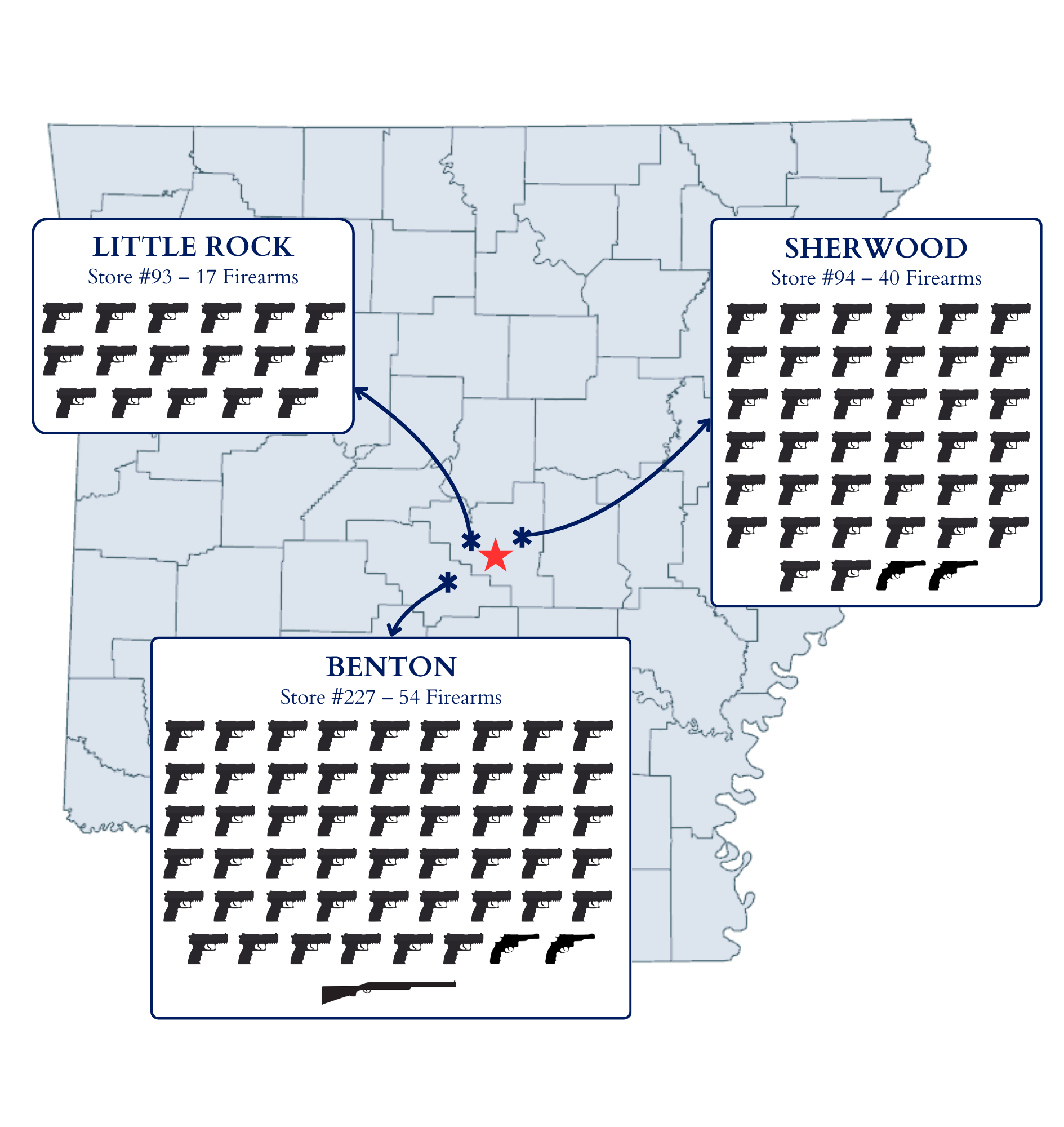
As previewed above in the Introduction, four Academy stores located in and around Little Rock, Arkansas44The four Academy stores that sold the guns at issue are: (1) Store #93 in Little Rock, Arkansas; (2) Store #94 in Sherwood, Arkansas; (3) Store #227 in Benton, Arkansas; and (4) Store #229 in Conway, Arkansas. The Little Rock store sits at the center of this group; each of the other three stores is within a 30-mile drive of the Little Rock store. sold Kyler Booker, a straw purchaser, at least 119 guns between January 2020 and September 2021, which he then supplied to one or more traffickers who moved the guns into New York City.45The prosecution described in this subsection is United States v. Booker, 22-cr-00489 (E.D.N.Y.). See Indictment, United States v. Booker, 22-cr-00489, ECF No. 1 (E.D.N.Y. Oct. 26, 2022); Detention Mem., United States v. Booker, No. 22-cr-0489, ECF No. 4 (E.D.N.Y. Nov. 2, 2022) (“Detention Mem.”); Exs. A-C to Sentencing Mem., United States v. Booker, 22-cr-00489, ECF Nos. 46-1-46-3 (E.D.N.Y. Jan. 16, 2026); see also Press Release, U.S. Att’y’s Off., E.D.N.Y., Defendant Charged with Trafficking Firearms from Arkansas to All Five Boroughs of New York City (Nov. 2, 2022), https://www.justice.gov/usao-edny/pr/defendant-charged-trafficking-firearms-arkansas-all-five-boroughs-new-york-city. One hundred eleven of those guns were sold by three Academy stores to Booker in just over four months, from September 2020 through January 2021. At least 12 of these firearms have already been recovered by the NYPD. (Booker also purchased an additional 11 firearms from another dealer in North Little Rock, not an Academy store, at least one of which has been recovered by the NYPD.46See Ex. B to Sentencing Mem., United States v. Booker, 22-cr-00489, ECF No. 46-2 (E.D.N.Y. Jan. 16, 2026); Detention Mem. at 13.) As noted above, Booker pleaded guilty in January 2025 to firearms trafficking conspiracy and making false statements to acquire firearms.
As reflected in the facts set forth in the criminal prosecution documents, Academy’s sales to Booker were replete with textbook red flag indicators47See supra Part A. of straw purchasing: (i) repeated bulk purchases within short periods of time; (ii) of the same or similar types of firearms; (iii) paid for entirely in cash. A graphic representation of these purchases is featured below. Full-page versions of this and the other graphics included in this report are also appended to the end of the report.
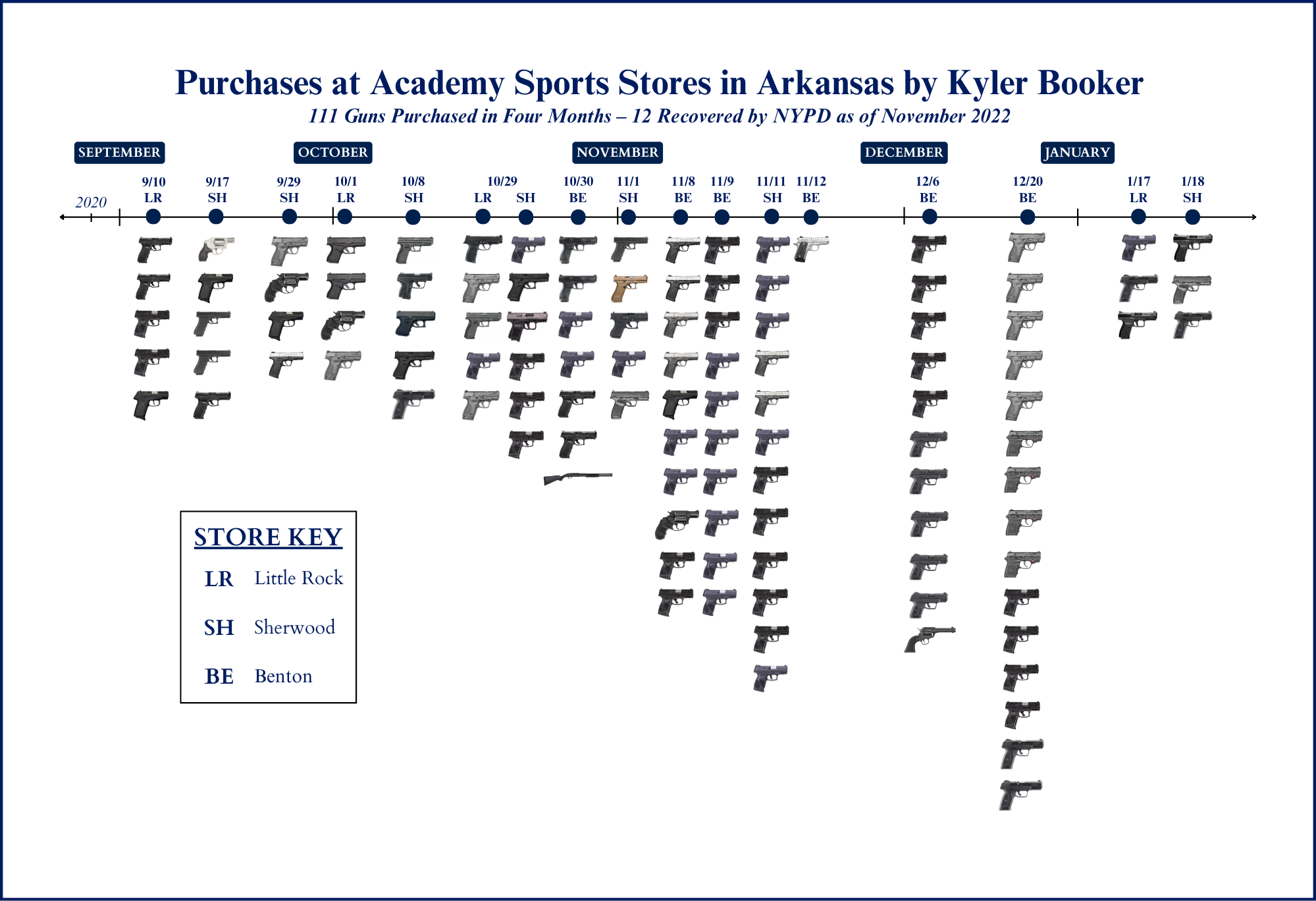
First, with only one exception, every single time Booker visited an Academy store to purchase firearms during this four-month period, he walked away with multiple guns. On average, he walked out with over six new guns after each visit to an Academy store. This data point alone is cause for alarm—and by federal law required and caused Academy stores to file numerous multiple sales reports with the ATF and local law enforcement48Records from the criminal case confirm that Academy filed these required multiple sales reports for almost all of the Booker multiple-purchase transactions, but these records do not appear to indicate whether Academy filed such reports in the remainder of the sales to Booker.—but some of his bulk purchasing sprees from Academy were particularly egregious. For example, on a single day in December 2020, one Academy store sold Booker 15 handguns; two weeks earlier in December, that same store had sold Booker 11 handguns. Similarly, over the course of two consecutive days the month before, in November, that same single Academy location sold Booker 20 handguns (10 each day), 14 of which were Taurus 9mm pistols. That buying sprint was part of a longer two-week period in October and November 2020 during which three Academy stores sold Booker 56 guns across just eight transactions. Thirty-two of those guns were identical or near-identical pistols.
As previously noted, out of the 119 total firearms that Academy sold to Booker, it sold 111 to him within roughly four months. Fifty-four of those 111 were sold to him by one store in Benton, Arkansas. This is an alarming number of firearms for one individual to purchase and is clearly inconsistent with personal use. Indeed, the Government described Booker’s purchasing pattern as “strongly indicative of commercial, rather than personal[] purchases” in a court filing.49Detention Mem. at 2.
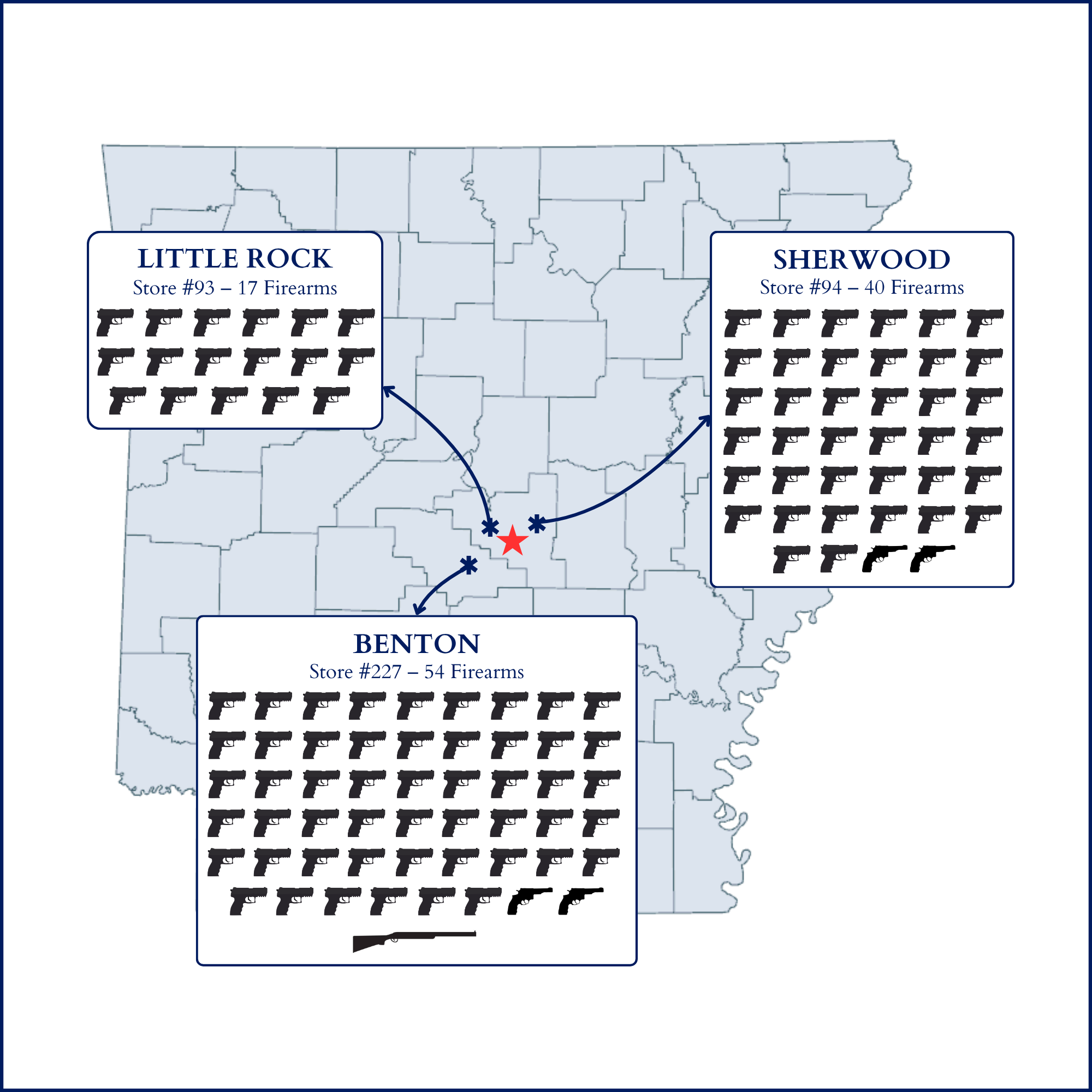
Second, 95 out of the 119 guns (79 percent) that Academy sold to Booker were 9mm pistols. Fifty-one of those 95 pistols were Taurus G2C or G3C pistols—that is, duplicates of two similar models belonging to the same line of pistols. In other words, approximately 43 percent of all the guns that Academy sold to Booker were nearly identical. As described above in Part A, this is another hallmark of straw purchasing identified by the ATF.
Third, Booker paid in cash for each of his firearms purchases at Academy. A single in-store buyer spending tens of thousands of dollars on guns within several months is already suspicious; payment of that amount in cash is an obvious marker of straw purchasing.
Despite the combined presence of these three categories of red flags, Academy did not stop Booker’s straw purchasing, resulting in over 100 guns being diverted to the criminal market. Academy failed to act over many months—and did not cut Booker off until after it appears that law enforcement flagged Booker’s purchases to Academy directly.50See supra note 45. According to documents filed as part of the criminal prosecution of Booker, he was first approached by ATF in February 2021—by which point he had already purchased at least 111 firearms—and was warned that he was engaged in unlicensed firearms dealing in violation of federal law. He was also provided with the paperwork to become a licensed FFL. Exs. E-F to Sentencing Mem., United States v. Booker, 22-cr-00489, ECF Nos. 46-5-46-6 (E.D.N.Y. Jan. 16, 2026). According to these same documents, Booker never applied to become an FFL, and instead continued bulk straw purchasing of weapons for others, leading ATF to speak with him again in October 2021. Ex. G to Sentencing Mem., United States v. Booker, 22-cr-00489, ECF No. 46-7 (E.D.N.Y. Jan. 16, 2026). Booker was “flagged” for no further purchases at Academy around the same time the ATF visited multiple Academy locations, all in or around October 2021. Id. at 3. Criminal charges were then initiated against Booker in October 2022.
Of the 119 guns sold by Academy to Booker, at least 12 had already been recovered by the NYPD as of November 2022—including one recovered in the possession of a person with a felony conviction and two recovered in the presence of minors (as further described below). These recoveries demonstrate the real public safety implications flowing from Academy’s repeated sales to a prolific straw purchaser. In addition, the whereabouts of 100 or more of the guns sold to Booker are unknown, but most are almost certainly still in circulation, potentially further jeopardizing public safety in New York and beyond. As one ATF agent explained with regard to straw purchasing, the unrecovered guns are “the scary part.”51Chuck Goudie & Ross Weidner, Chicago gun violence, drug cartel mayhem fueled by straw purchases, ABC-7 (Nov. 11, 2019), https://abc7chicago.com/straw-purchases-fuel-chicago-gunviolence-drug-cartel-mayhem/5690949/.
Details of the 12 known NYPD recoveries reinforce the public safety risk:
- November 10, 2020: The NYPD recovered a loaded Taurus 9mm pistol in Queens, a mere 12 days after Booker purchased the gun from the Academy store in Sherwood, Arkansas. The possessor pleaded guilty to second-degree criminal possession of a loaded firearm.
- December 29, 2020: The NYPD recovered a Glock pistol that Booker purchased from the Little Rock, Arkansas store less than three months earlier. The pistol was recovered from the backseat of a taxi, while a minor was sitting in the taxi.
- February 12, 2021: The NYPD recovered a loaded Taurus 9mm pistol from a party bus in Brooklyn, only three months after Academy’s Sherwood store sold the gun to Booker. The pistol was one of seven guns recovered from the bus.
- March 10, 2021: The NYPD recovered a loaded Smith & Wesson pistol in Brooklyn; Academy’s Benton, Arkansas store sold the gun to Booker less than three months earlier.
- April 2, 2021: While executing a search warrant on Staten Island, the NYPD recovered a loaded Taurus 9mm pistol that Academy’s Benton store sold to Booker five months earlier.
- June 19, 2021: The NYPD recovered a loaded Ruger 9mm pistol from a minor in Brooklyn; Academy’s Little Rock store sold Booker the gun six months and two days earlier.
- September 22, 2021: The NYPD recovered a loaded Taurus 9mm pistol in Harlem, for which three individuals were arrested and charged with criminal possession of a loaded firearm with intent to use it against another. Academy’s Benton store sold Booker the gun nine months earlier.
- October 20, 2021: The NYPD recovered a loaded Smith & Wesson pistol in Brooklyn. An individual was arrested and charged with criminal second-degree possession of a loaded firearm. Academy’s Little Rock store sold Booker the gun one year prior.
- November 18, 2021: The NYPD recovered a Beretta 9mm pistol with a shell casing in the chamber from the street in the Bronx, less than three months after Academy’s Little Rock store sold Booker the gun.
- December 10, 2021: The NYPD recovered a loaded Taurus 9mm pistol in Brooklyn. An individual was arrested, charged with criminal second-degree possession of a loaded firearm in connection with the gun, and later convicted and sentenced to five years imprisonment. Academy’s Benton store sold Booker the pistol in November 2020.
- January 27, 2022: The NYPD recovered a loaded Taurus 9mm pistol in Harlem and charged the possessor—who was already on parole—with first-degree armed robbery while displaying a firearm the following day. The possessor was later sentenced to ten years imprisonment. Academy’s Little Rock store sold Booker the pistol less than five months earlier.
- May 8, 2022: The NYPD recovered a loaded Smith & Wesson pistol from a burglary parolee in Brooklyn, less than a year and a half after Academy’s Benton store sold it to Booker.
The time-to-recovery for over two-thirds of these guns was roughly six months or less; and, as noted above, one gun was recovered in New York City only 12 days after the straw buyer purchased it from Academy. As also noted above, see supra note 22, these short “time-to-crime” recoveries are strong indicators of trafficking.
2. Thirteen Academy Stores in Georgia Sold 119 Guns to Four Straw Buyers
Firearms sold by Academy stores also supplied a trafficking scheme that sourced 290 firearms from Academy and numerous other retailers and moved guns from Georgia to Philadelphia. As detailed in court filings, 13 Academy stores located in the Atlanta area sold 119 of these guns to four of the individuals who were part of this multi-conspirator trafficking operation between July and November 2020.52The prosecution described in this subsection is United States v. Norman, 22-cr-00098 (E.D. Pa.). See Second Superseding Indictment, United States v. Norman, 22-cr-00098, ECF No. 158 (E.D. Pa. Jan. 5, 2023); see also Indictment, United States v. Norman, 22-cr-00098, ECF No. 1 (E.D. Pa. Mar. 17, 2022) (initial indictment charging all four Academy Sports straw purchasers, among other defendants); ECF Nos. 249, 293, 320, 349, United States v. Norman, 22-cr-00098 (E.D. Pa.) (reflecting the guilty pleas and sentences of the four Academy Sports straw purchasers). The 13 Academy Sports stores that sold the guns at issue are: (1) Store #107, in Snellville, Georgia; (2) Store #110, in McDonough, Georgia; (3) Store #118, in Cumming, Georgia; (4) Store #124, in Hiram, Georgia; (5) Store #157 in Newnan, Georgia; (6) Store #169 in Douglasville, Georgia; (7) Store #179 in Dalton, Georgia; (8) Store #190 Macon, Georgia; (9) Store #192 in Athens, Georgia; (10) Store #199 in Cartersville, Georgia; (11) Store #224 in Gainesville, Georgia; (12) Store #257 in Buford, Georgia; and (13) Store #260 in Kennesaw, Georgia. According to federal prosecutors, this “unprecedented” trafficking operation transported the combined stock to Philadelphia.53Press Release, U.S. Att’y’s Off., E.D. Pa., Latest Prison Sentence in Unprecedented Firearms Trafficking Operation (Nov. 15, 2023), https://www.justice.gov/usao-edpa/pr/latest-prison-sentence-unprecedented-firearms-trafficking-operation. The four straw purchasers all have pleaded guilty.
This Part describes each of the four straw purchasers based on court filings, tracking the emergence of this pattern. Graphic representations of these purchases are included below.
a. Academy Sales to Frederick Norman
The 13 Academy stores at issue sold Frederick Norman 67 guns over just five months, between July and November 2020. (In addition to making straw purchases himself, Norman also recruited other straw purchasers.) First, on July 11 and 12, 2020, three Academy stores sold Frederick Norman a total of seven pistols. In August 2020, over the course of just five days, three Academy stores sold Norman another seven pistols. In September 2020, seven Academy stores sold Norman 11 pistols. In October, sales to Norman increased: nine Academy stores sold Norman 20 guns. In November, eight Academy stores sold him 22 guns. This rapid, high-volume purchasing is a recognized red flag of straw purchasing. But Academy did not intervene and stop the sales, even though, as described below (see Part C(4)), it appears to have had the capacity to track such purchases across stores.
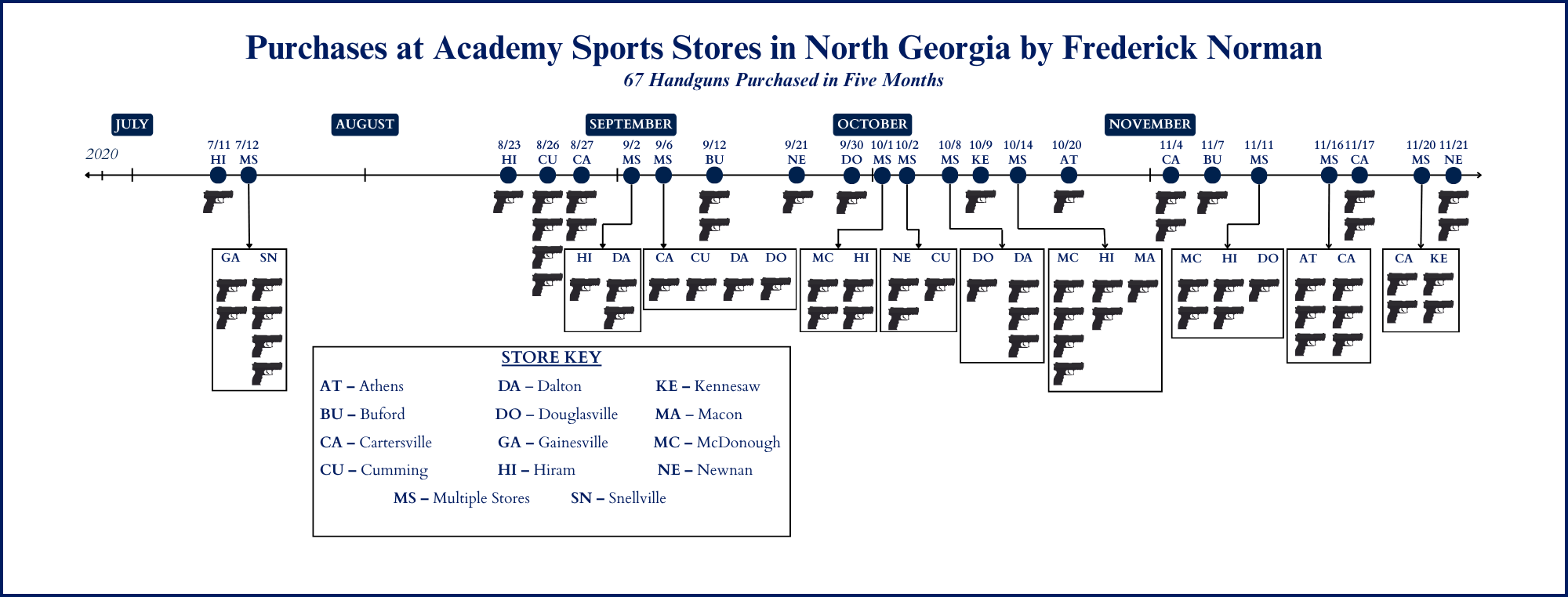
Moreover, Norman’s frequent purchase of duplicate guns presented another red flag that he was engaged in straw purchasing. Approximately half (17 out of 36) of Academy’s sales to Norman included two or more identical guns. Even on a smaller scale, his purchases from individual stores often involved suspicious patterns. For instance, over the course of five days, from November 16 to 20, 2020, Norman purchased seven identical Taurus G2C 9mm pistols from Academy’s Cartersville, Georgia store.
At least two 9mm pistols sold by Academy to Norman have been recovered by the Philadelphia Police Department, one during execution of a search warrant and the other in connection with the arrest of an individual who was charged with carrying firearms in a public place.54See Aff. in Supp. of Search Warrant, In re Search of the ICloud Account Assoc. with E-mail Address “sailesproductions@yahoo.com” Stored at Premises Controlled by Apple, Inc., No. 21-mj-000005, ECF No. 1 (E.D. Pa. Jan. 5, 2021) (“Search Warrant Affidavit”); Docket Sheet, Commonwealth v. Bruce, No. MC-51-CR-0022803-2020 (Municipal Ct. of Philadelphia County), https://ujsportal.pacourts.us/Report/CpDocketSheet?docketNumber=MC-51-CR-0022803-2020&dnh=LLUWAR6j0czhc8l2XvOSzg%3D%3D. The former was recovered on September 3, 2020, during the period of Norman’s active straw purchasing. The gun, a Smith & Wesson 9mm pistol, was recovered less than two months after Norman purchased it from Academy’s Snellville, Georgia store.
(According to the indictment, other firearms retailers in addition to Academy also supplied this trafficking scheme through Norman (and others), including one retailer that sold Norman 13 pistols—including multiple duplicates—over a two-day period on July 16-17, 2020.55See Second Superseding Indictment ¶ 24(c), 25(a), United States v. Norman, 22-cr-00098, ECF No. 158 (E.D. Pa. Jan. 5, 2023) (describing purchases of 13 firearms from Appalachian Gun and Pawn in Jasper, Georgia).)
b. Academy Sales to Charles O’Bannon
Over the course of two and a half months, between August 31 and November 11, 2020, 10 Academy stores sold 28 guns to Charles O’Bannon, many of which were duplicates of the same models. This represents an overall purchasing rate nearly as rapid as Norman’s.56The public record does not reveal whether Norman and O’Bannon conducted any of their purchases from Academy, or otherwise frequented the stores, together. But court filings do show that they were childhood friends and that they purchased guns from the same Academy store on the same day on at least one occasion. See Def. Request for Downward Variance and Sentencing Mem. at 1, United States v. O’Bannon, No. 22-cr-00098, ECF No. 307 (E.D. Pa. Oct. 31, 2023). These facts suggest that Norman and O’Bannon may have shopped together on some occasions.
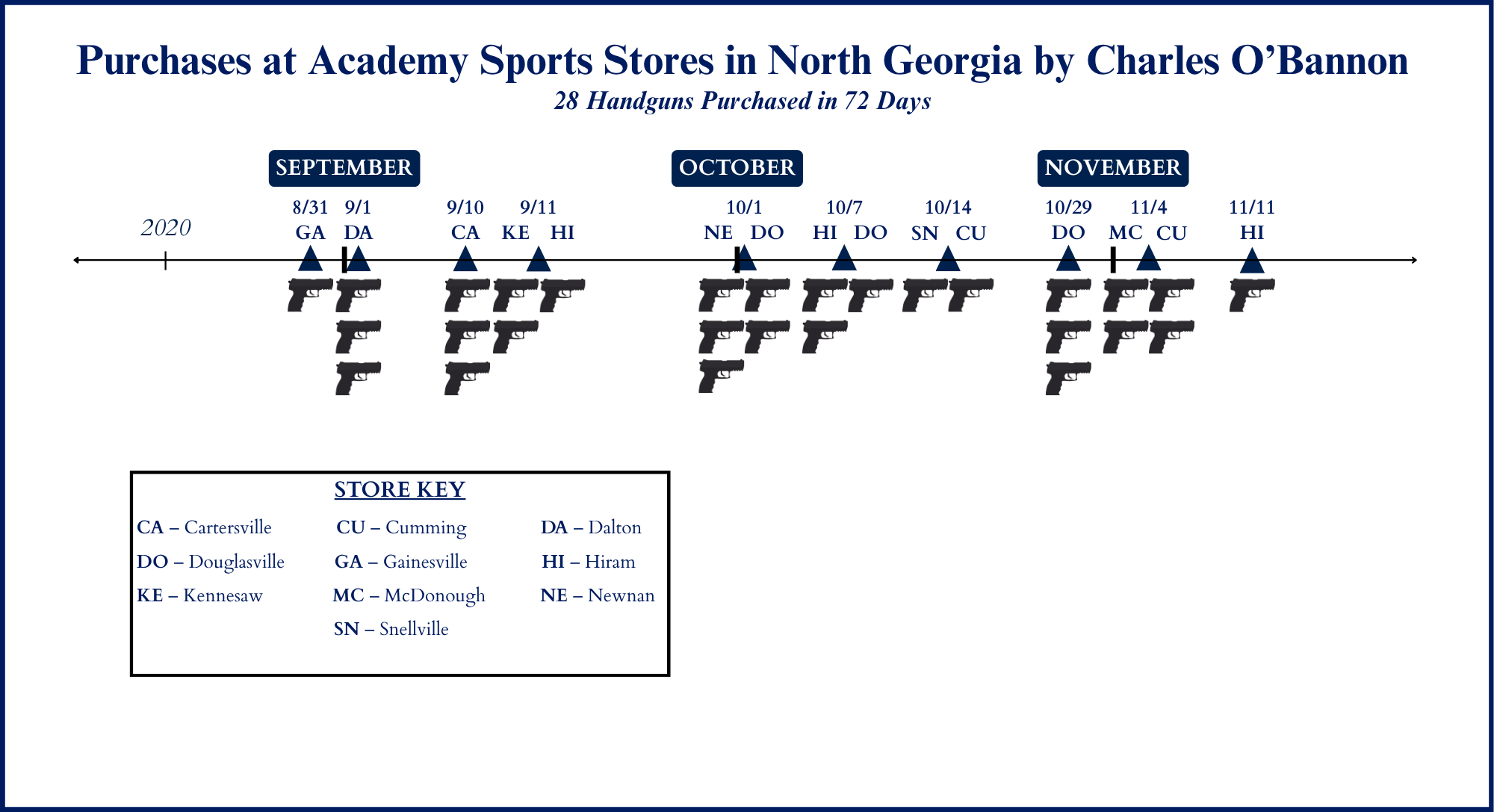
Aside from the alarming overall number of sales to O’Bannon, Academy’s sales to him occurred in several compressed bursts. First, Academy stores sold O’Bannon 10 guns over 12 days between August 31 and September 11, 2020. In the first seven days of October, Academy stores sold O’Bannon eight guns, along with an additional five guns later in the month. And in early November, Academy sold O’Bannon five guns in just eight days.
c. Academy Sales to Brianna Walker
Over the course of the same five-month period as its sales to Norman, 10 Academy stores sold Brianna Walker 17 guns. In July and September 2020, Academy sold Walker four guns. In October, five Academy stores sold Walker six guns. In November, three Academy stores sold Walker seven guns.

The guns sold to Walker included duplicates of several models, including seven Taurus G2C 9mm pistols. At least one of the guns that Academy sold to Walker—a Glock 19 9mm pistol—was recovered by the NYPD, on July 9, 2021, from an individual arrested on charges related to their possession of firearms and ammunition.
Though not as voluminous as its sales to Frederick Norman or O’Bannon, Academy’s overall sales to Walker were numerous enough to constitute a recognized red flag of straw purchasing, especially considering the number of duplicates. Moreover, court filings suggest that Norman and Walker often shopped together.57See Search Warrant Affidavit ¶ 39 (recounting statement from another licensed dealer that Norman and Walker were “usually together”).
d. Academy Sales to Stephen Norman
Five Academy stores sold Stephen Norman—Frederick Norman’s brother—seven guns over just two weeks in October 2020. His purchases consisted of two pairs of duplicate guns and one triplicate of identical guns.

In sum, the facts set forth in criminal filings lay out how Academy’s Atlanta-area stores were presented with numerous red flags that many of the sales to the Normans, Walker and O’Bannon were to straw purchasers. Academy’s failure to intervene and stop the sales was a missed opportunity to prevent its guns from being fed into the criminal market.
Additionally, facts set forth in other criminal prosecution filings detail how some of these same Atlanta-area Academy stores sold numerous firearms to other straw purchasing and trafficking rings in and around the same time periods:
First, five of the 13 Atlanta-area Academy stores that supplied the Norman scheme described above later sold a combined 13 pistols to one straw buyer, Gregory Bournes Jr., between July 2021 and January 2022, including six pistols in less than four weeks by three different Academy stores.58See United States Omnibus Mem. in Aid of Sentencing, United States v. Bournes, No. 23-CR-74, ECF No. 58 (D.D.C. Feb. 23, 2024). (This trafficking operation sourced dozens of other guns from multiple other retailers as well, not just Academy, and involved a second straw purchaser.) Four of those 13 trafficked Academy firearms have been recovered by law enforcement thus far. One has been linked to seven incidents in Washington, D.C., including three shootings and an armed carjacking and shooting.59See id. at 19-20. Bournes pleaded guilty to a federal conspiracy charge and was sentenced February 2024.
Second, yet another trafficking scheme involved purchases from two of the same Atlanta-area Academy stores as those implicated in the Norman scheme described above, and during the same period. These two Academy stores sold a straw purchaser, Patrick Polidore, a combined 10 handguns over the course of less than a month in October and November 2020.60See Gov’t Sentencing Mem., United States v. Wolfolk, No. 22-cr-00347-JMA, ECF No. 40 (E.D.N.Y. Sep. 27, 2023). Eight of these firearms were sold to Polidore over the course of two days by two Academy locations. (This trafficking operation also sourced guns from multiple retailers, not just Academy.) At least three of these Academy-sold guns have already been recovered by law enforcement: one from a suspect fleeing a robbery in Bethpage, New York; one from a parolee in Lynbrook, New York; and one in Hempstead, New York.61See id. at 4-5. Polidore pleaded guilty to a federal charge arising from this scheme and was sentenced in July 2025.
3. An Account from One Straw Purchaser
As part of its investigation, Everytown conducted an interview with an individual who made a large number of illegal straw firearms purchases from Academy stores.62To lessen the chance of retaliation against the straw purchaser, including by those to whom he supplied the weapons directly or indirectly, by agreement we do not name him here. The interview sheds additional light on Academy’s conduct.
Because this interview contains rare insights into the relationship between a straw purchaser and a large-scale seller, we share details about it here. In conducting the interview and in our follow-up due diligence, Everytown was cognizant that this straw purchaser, like all straw purchasers, had lied repeatedly on his ATF Form 4473s by attesting that he was purchasing firearms for himself rather than any third party. And in this case, the purchaser lied in statements to law enforcement agents and in other contexts as well. Accordingly, Everytown has examined the straw purchaser’s claims in light of other, verifiable evidence. Although Everytown cannot corroborate every statement made by the straw purchaser, we found his statements to be consistent with the quantity, timing, and type of purchases he made, as well as with Academy’s failures to stop these straw purchases for months. We also note that the straw purchaser has admitted his guilt and pleaded guilty to serious federal felony charges.
The straw purchaser described an environment in the 2020-2021 time period in which he knew several of the Academy employees who regularly staffed the gun counters, and they knew him, by face and/or by name. That is, Academy staff who sold him guns remembered him from prior purchases, or from the local firearms community. Even if Academy staff did not remember him personally, Academy’s customer data tracking systems (described below) would have, or should have, provided them with the data necessary to recognize his alarming purchasing patterns both within individual stores and across multiple stores. And yet, the straw purchaser reports that, until his scheme was stopped by ATF intervention, no Academy employee ever refused a sale, asked him why he was purchasing large multiples of the same handgun, or even inquired as to whether he was buying such a large number of guns for himself or for someone else, as the ATF encourages dealers to do, see supra Part A. In short, while the straw purchaser reported that he never expressly told Academy employees he intended to resell the guns, he did not recall experiencing any added scrutiny by Academy employees with regard to his repeated unlawful purchases.
Indeed, far from declining or even scrutinizing his purchases, the straw purchaser advised that Academy staff would as a matter of course ask him “how many” of a particular firearm model he wished to purchase. He similarly recalled that, on multiple occasions, Academy staff volunteered information to him about inventory at other Academy stores when they were not able to fully supply a bulk sale. The straw purchaser noted that he did not need to ask Academy staff for this information before they offered it—and, in fact, that he himself would not have asked for fear of arousing suspicion. Academy staff would also provide him with other incentives, such as discounts and free ammunition, to encourage additional purchasing. And on at least one occasion, an Academy employee proactively contacted him about new shipments of cheap handgun models. None of this appeared to surprise the straw purchaser, and indeed he stated that it is known that you can buy as many guns as you want at Academy.
The straw purchaser recounted additional conduct on his part during this same 2020-2021 time period that constituted red flags of straw purchasing as identified by the ATF and the industry. He described several instances in which he spoke to the actual purchaser by phone while at the gun counter, in order to discuss the available inventory. He likewise described sending the actual purchaser photos of inventory from inside the store, showing different available colors or models, for instance. Both of these behaviors are classic red flags of straw purchasing. See supra Part A. Additionally, he recalled asking at least one Academy employee about how he should answer the “actual buyer” question on the Form 4473, which should have raised alarm bells. Instead, the straw purchaser recalled the employee telling him that he must answer on the Form 4473 that he is the actual buyer, or the store cannot sell to him. Finally, he explained that an Academy employee, usually a store manager, would generally accompany him and his bulk-purchased firearms to his car after the purchase. He revealed that in several instances, the actual purchaser was waiting in his car in the Academy parking lot, and that he would simply hand over the newly purchased firearms.
Consequently, the straw purchaser was able—with no apparent pushback from Academy employees—to divert a multitude of guns from Academy’s inventory to the illicit market.
4. Academy’s Conduct at the Corporate Level
According to the criminal filings, the trafficking schemes described above operated in plain sight. The Academy stores at issue were presented with multiple well-recognized straw purchasing red flags, including frequent, rapid, extraordinary bulk purchasing—often of identical or near-identical pistols—but did not stop supplying the trafficking schemes.
Significantly, the facts collected in this report from numerous criminal filings raise serious questions as to whether Academy failed to adequately monitor and/or act upon available company-wide data that could have made clear that many of these straw buyers were compounding their high-volume purchasing by frequenting multiple Academy locations. Public information reveals that Academy tracks customers across stores and has information sufficient to recognize when a purchaser is aggregating bulk firearms purchases across stores. Specifically, Academy collects customer information through in-store purchases, as part of its broader tracking of customer data.63See Privacy Policy, Acad. Sports & Outdoors, (June 30, 2025), https://www.academy.com/privacy-policy (“2. How We Collect Personal Data . . . From you in person. This includes personal data collected when you shop with us at our stores, including through your purchases. . . .”). This information includes, among other things, products purchased and personal data submitted via point-of-sale devices.64Id. Customer data enables Academy to know what its customers buy: “We also utilize customer demographic data that we capture to know when our customers buy from us and what items they purchase.”65Acad. Sports & Outdoors, Inc., Annual Report (Form 10-K) 10 (Mar. 29, 2022) (emphasis added), https://investors.academy.com/static-files/c1c2897c-638a-4f97-a336-65be63d8d73a. Importantly, Academy centralizes this data: the company boasted that its “robust customer database has 40 million unique customers” as of 2020, and the company is able to estimate the number of unique customers who shop with Academy in a given year.66See Acad. Sports & Outdoors, Inc., Annual Report (Form 10-K) 6, 14 (Apr. 7, 2021), https://investors.academy.com/static-files/1902636c-42cd-4fc8-8535-aadb29a6f9e7.
In the previously referenced lawsuit against Academy arising out of a straw purchasing scheme leading to an Academy-sold gun being used in a triple homicide (see supra at 4-5), a 2023 report by an expert for the plaintiff asserts that Academy “had the technological capability to retrieve buyers’ histories but it was not their practice to do so,” and that, as of an unspecified date, “Academy also installed a computer system that listed all previous sales of firearms by an individual that could easily be accessed to allow the salesclerk to examine previous firearm purchases.”67See Ex. 3 to Def.’s Mem. Opp. Pls.’ Mot. Compel, supra note 16, at 33, 36. The expert further claimed that Academy sales staff were not adequately trained on and did not regularly check this information as a matter of practice.68See id. at 33, 36-37. (As noted above, while Academy settled this case for $2.5 million, it did not admit liability and it denied wrongdoing, asserting, among other things, that it “has implemented reasonable policies, procedures, and training designed to prevent [straw] purchases from occurring at its store locations”69Def.’s Am. Answer and Crosscl. ¶¶ 40-41, Coxie v. Academy, Ltd., No. 2018-CP-42-04297 (S.C. Ct. Com. Pl. Seventh Jud. Cir. Sept. 27, 2019). and citing expert testimony and other evidence that it claimed demonstrated that the straw purchaser there “was undetectable as a straw purchaser and presented no indicia of improper conduct when purchasing his firearms.”70Def.’s Mot. for Summary Judgment at 2, Coxie v. Academy, Ltd., No. 2018-CP-42-04297 (S.C. Ct. Com. Pl. Seventh Jud. Cir. Oct. 20, 2023).).
As of 2021, Academy publicly reported that its “[f]irearm inventories and transactions are tracked in a digital system,” and that the company maintains an “internal denial database system” for firearms sales.71Acad. Sports & Outdoors, supra note 1, at 8-9 (emphasis added). Additionally, Academy has, or at one time had, firearms sales policies in place that required firearm department employees to check a prospective buyer’s information against Academy’s systems for certain warning flags, including of a potential straw purchase. Academy has also acknowledged the importance of sharing information about suspicious firearm purchasers between and among stores in its written policies concerning denied sales.72See Pet. for Writ of Mandamus at MR 334, In re Acad., Ltd., 625 S.W.3d 19 (Tex. 2021) No. 19-0497 (noting that identifying information is essential “to properly identify the prohibited customer if he/she tries to purchase a firearm at another Academy location”). Significantly, other large chain firearms retailers employ systems that monitor and allow corporate-level staff to act upon company-wide firearm purchasing data to help identify straw purchasers,73See , e.g., Def.’s Mem. Supp. Mot. Summ. J. at 6-7, Minnesota v. Fleet Farm LLC, No. 22-cv-02694, ECF No. 200 (D. Minn. Apr. 4, 2025) (“[S]ince ‘the start of 2022,’ corporate-level employees have been able to ‘monitor[] and evaluat[e] multiple gun purchases’ across stores ‘to identify possible straw buyers.’” (citations omitted)). and as noted above, Fleet Farm recently entered into a settlement agreement that requires implementation of a software system “that tracks and displays a prospective buyer’s firearm purchase history . . . to Fleet Farm employees at the point of sale.”74Consent Judgment at 5-6, Minnesota v. Fleet Farm LLC, No. 22-cv-02694, ECF No. 255 (Feb. 24, 2026). Implementing systems that utilize company-wide data to identify suspicious purchasing patterns is thus not only feasible, but—if not already a required query in connection with all firearms sales by Academy stores—would bring Academy in line with the firearms sales practices of some other similar chain retailers.
More broadly, as previously noted, Academy held itself out as a model corporate citizen in its 2021 ESG Report, claiming that it is “deeply committed to ensuring the safe, compliant, and responsible . . . sale[] and transfer of firearms” and “strive[s] to be the most responsible firearms retailer in the country.”75Acad. Sports & Outdoors, supra note 1, at 8. Academy further states that firearms sales “[r]ecords and paperwork are reviewed twice daily and are subject to six different types of audits by four different management levels” and claims that its firearms sales team members receive “ongoing training.”76Id. at 8-9. (Additional excerpts from Academy’s ESG Report describing its approach to “Firearm Responsibility” are attached in full at the end of this Report.) In short, Academy has the capacity—and, we believe, the obligation—to track firearms purchasers within and across its stores in order to identify and disrupt suspicious purchasing patterns and ensure compliance with its stores’ duties as licensed dealers. Indeed, Academy’s directors’ fiduciary duties to shareholders—and the company’s responsibility to the communities it serves—require mitigation of these outsized risks.
(As noted at the outset, other than the one lawsuit referenced herein dealing with a separate straw purchaser, we are not aware of Academy or any of its employees or Board members being prosecuted, civilly sued, or found liable for any of the firearms sales or sales practices discussed in this report.)
Conclusion
Unless it has already done so, Academy should investigate the transactions discussed in this report, determine what happened and whether and where its policies and procedures may be deficient, and take concrete steps to remedy any issues and mitigate these risks going forward. Critical questions that regulators, management, and the Board must demand answers to include:
- Are Academy firearms salespersons and their managers being adequately trained and supervised?
- Does Academy’s training regarding firearms sales—including written materials and training presentations—adequately cover red flags of straw purchasing?
- Are Academy firearms salespersons and their managers trained to (and do they) check Academy’s computerized customer information for suspicious firearms purchase patterns within single stores and across multiple locations?
- Are these same individuals instructed to ask questions—such as “Who are you buying this/these gun[s] for today?”—if they have any suspicions of illegality, as the gun industry’s trade group NSSF recommends?
- Do Academy firearms salespersons or their managers receive commissions based on the amount or value of their firearms sales?
- Does Academy, at the corporate level, monitor multiple sales reports filed by its stores with the ATF for suspicious buying patterns?
- Does Academy, at the corporate level, monitor and analyze trace requests received from the ATF and company-wide firearms purchase and denial records for suspicious buying patterns?77In the prior litigation against Academy referenced supra at 4-5 & 22, Academy’s Senior Director of Compliance submitted an affidavit indicating that Academy’s compliance department has logged trace requests on spreadsheets. See Perry Davis Aff. ¶ 24, Coxie v. Academy, Ltd., No. 2018-CP-42-04297 (S.C. Ct. Com. Pl. Seventh Jud. Cir. June 22, 2023).
- Did the Academy stores discussed above and/or Academy compliance and corporate management fail to detect or take remedial action in the face of the above-documented patterns of straw purchasing? Did these stores and/or Academy compliance or corporate management take any timely steps to stop this straw purchasing?
- Were the transactions and patterns of sales outlined in this report actually “reviewed twice daily and . . . subject[ed] to six different types of audits by four management levels,” per Academy’s publicly proclaimed process?78Acad. Sports & Outdoors, supra note 1, at 8. If not, why not? If so, did those reviews and audits miss these patterns of straw purchasing?
- Were any employees disciplined in connection with the patterns of straw sales outlined herein? If not, why not?
- Were the federal firearms licenses of individual Academy stores or Academy at the corporate level subject to any investigations, warnings, or remedial action by the ATF in connection with the above-outlined straw sales?
In addition to urging outside regulatory scrutiny, Everytown strongly urges Academy’s Board of Directors to retain an independent outside firm to investigate and make recommendations with respect to the substance of and compliance with Academy’s firearms sales policies, procedures, and training. Such investigation and recommendations should at a minimum include:
- Reviewing and strengthening Academy’s straw-purchase-prevention policies and procedures, including in comparison to leading industry standards;
- Preparing and publishing a public shareholder report detailing Academy’s straw-purchase-prevention policies and procedures, and employee compliance with the same;
- Confirming that Academy has the technical infrastructure to enable employees selling firearms to check the names and other information of firearms customers against a centralized database that aggregates firearms sales information from every Academy store;
- If not already in place, requiring employees at every Academy store that sells firearms to check a firearms buyer’s name and other information against said centralized database prior to completing the sale, and to decline sales to buyers who have engaged in suspicious purchasing patterns either within one store or among multiple stores;
- If not already in place, developing the technical infrastructure to enable centralized monitoring at the corporate level of multiple sales reports filed by stores with the ATF and trace requests received from the ATF, including by providing automatic alerts when Academy receives a trace request from the ATF for a recovered gun purchased from any Academy store within the prior three years;
- If not already in place, developing and regularly updating a database of purchasers who bought guns for which Academy received an ATF trace request less than three years after the date of purchase, and making the list accessible to all Academy employees engaged in firearms sales;
- Developing strict guidelines to control further firearms sales to purchasers appearing in the database described immediately above;
- If not already in place, instituting a process to review and scrutinize employees who sell an unusually high volume or disproportionate number of firearms;
- Taking disciplinary action against employees who have not complied or do not comply with Academy’s firearms sales policies and procedures, or who otherwise interfere with Academy’s legal obligation to prevent straw sales.